
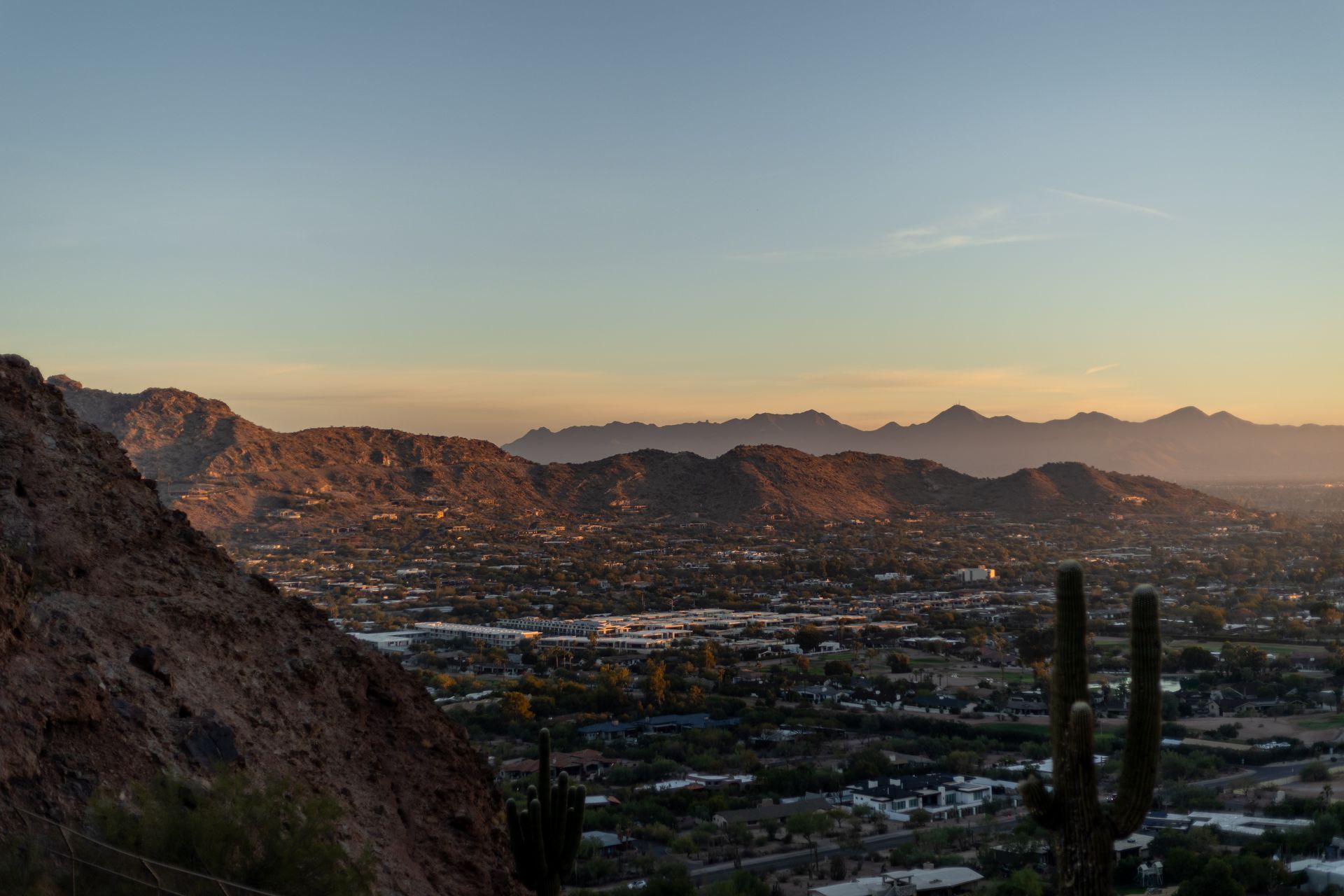
A Phoenix summer, hour by hour
It’s 4:58 PM in July. Your electricity is about to cost nearly three times as much.
Most Phoenix homes fight the afternoon by brute force. Here is the quieter way a house can get through a 115° weekday — and what it is worth.
By the Ideal Automation team9-minute read
In the summer of 2024, Phoenix stayed at or above 100 degrees for 113 days in a row.1 It hit 110 on seventy separate days.2 A year earlier, the city recorded its warmest night ever: the temperature never fell below 97.3
Numbers like that stop being weather and start being a line item. A quarter of all the energy used in Arizona homes goes to air conditioning — more than four times the national share.4 And on a time-of-use plan — the kind both APS and SRP offer — the same kilowatt-hour costs wildly different amounts depending on the hour you use it.
So the question isn’t whether your AC will run hard in July. It’s when. Here is one weekday in the life of a house that has been taught to care.
One July weekday, as the house lives it
Times assume APS’s 4–7 PM on-peak window. On SRP’s Conserve plan, slide the evening chapters two hours later.
5:30
AM · off-peak · 12.3¢
The cheapest cold of the day
Outside it’s already pushing 90. Inside, the thermostat quietly drops a couple of degrees below its usual setting. Off-peak power on APS’s time-of-use plan costs about 12 cents a kilowatt-hour; by late afternoon the same electricity will cost nearly three times that.5
This is pre-cooling, and it isn’t a trick — it is what APS itself tells customers to do: run a few degrees cooler for several hours during the day, then let the setpoint rise during on-peak.8 The difference is that nobody in this house has to remember. The schedule follows the forecast and the calendar, not a sticky note.
9:00
AM · everyone leaves
The house doesn’t stop paying attention
The last car pulls out. The dog stays. On a normal thermostat, “away” means guessing a number and hoping. Here, away mode holds a pet-safe temperature, and the phone shows the actual indoor reading from anywhere — the office, the airport, a beach in San Diego.
East-facing shades, closed against the morning sun, now lift to let in daylight on the shaded side of the house. Nobody touched them.
2:00
PM · the west wall wakes up
The sun moves to the side of the house that hurts
By early afternoon the sun swings onto west and south glass, and the house’s biggest weakness comes into play. APS’s own guidance has long put windows at roughly half of a desert home’s summer heat gain.11

So at two o’clock, motorized shades on the west and south windows lower themselves — triggered by the sun’s position, not a fixed time, so they track the season. In research for the U.S. Department of Energy, automated cellular shades cut HVAC energy about 15% compared with blinds used the way people actually use them.12 Exterior solar screens can do more.13
How much is your glass costing you? Move the slider below.
Try it on your house
What the west windows cost between 4 and 7
A rough, back-of-envelope estimate for one July weekday afternoon — not a quote, and not a promise of savings. Assumptions are listed below.
For scale: a 12-ft sliding door is about 96 sq ft; a typical 3×5 window is 15.
At 2 PM, the shades…
Sun heat through that glass
12,300Btu/hr
Roughly 1.0 ton of air conditioning working just to cancel it out.
On-peak cooling cost of that heat, per summer month
$28
On APS’s demand-charge plan, that load could also add about $24 a month in demand charges.
Flip the shades switch to see the difference a 2 PM close can make.
Assumptions behind these numbers
- Rates: APS Time of Use 4pm–7pm Weekdays on-peak 34.4¢/kWh; SRP Conserve 6–9 p.m. and Save (July–August) on-peak 40.2¢/kWh (source 5, 7). Excludes fixed charges, adjustors and taxes.
- Double-pane glass passes about 57% of the sun’s heat (SHGC 0.57, source 12).
- Our assumption: ~180 Btu/hr of sun per sq ft on west glass, averaged over a clear July afternoon; 3 sun-hours inside APS’s window and 1.5 inside SRP’s (sunset is around 7:40 PM); 22 weekdays a month.
- Our assumption: an air conditioner moving about 10 Btu per watt-hour (EER 10).
- Closed shades cut window solar gain by an assumed 40–70%: typical interior fabrics at the low end, tight exterior solar screens at the high end.
- APS demand plan: $19.585/kW on your single highest on-peak hour (source 6); we assume this glass load lands in that hour.
- Real results depend on overhangs, tint, orientation, insulation and how you live.
3:55
PM · last call
Banking the cold
Five minutes before the rate jumps, the system makes one last push: a final degree of cooling while power is still cheap. The house has spent the day storing cold in its drywall, furniture and air. Now it is going to spend it.

34.4¢ at 4:00 PM. 12.3¢ at 3:59.5
4:00
PM · on-peak begins
The house coasts, and the bill doesn’t spike
The setpoint rises a few degrees and the AC finally rests. With the shades already down and the house pre-chilled, the indoor temperature drifts up slowly instead of snapping back. On SRP’s Conserve plan the expensive window is 6 to 9 PM, and in July and August it runs 40.2¢ a kilowatt-hour.7
If you’re on APS’s demand-charge plan, one more thing matters: the single busiest hour of the month’s on-peak window sets a charge of about $19.59 for every kilowatt.6 That is why a well-programmed house also staggers the pool pump, the dryer and the car charger away from 4 to 7 — one careless afternoon can set the price for the whole month.
On some afternoons the utility may ask for help. APS’s Cool Rewards and SRP’s Bring Your Own Thermostat programs nudge enrolled thermostats up for a few hours during grid emergencies — and pay you for it.910 A house that already pre-cooled barely notices. (Eligibility depends on the thermostat model; more on that below.)
5:40
PM · the wall of dust
Then the monsoon shows up
Late August. A brown wall rolls in from the south and the lights flicker out. On one evening in 2025, up to 54,000 SRP customers and 12,000 APS customers lost power at the storm’s peak.14
An automated house can’t stop an outage. What it can do is tell you. Your phone gets a note when the power drops and another when it comes back; the thermostats return to their schedules on their own; shades settle into a safe position. If you are at work and the dog is home, that second notification is the one that matters. A small battery on the network gear keeps the messages flowing.
7:01
PM · off-peak returns
The house exhales
The rate drops back. The AC catches up on the cheap side of the clock, and the west shades rise to give back the view just as the sky turns orange. Pool and landscape lighting come up on the same scene. One button, or none at all.

10:30
PM · still 90-something
Overnight, it’s still hot. The house knows.
Phoenix summer nights barely cool off; the record for the warmest low is 97 degrees.3 Bedrooms get their own sleeping setpoint while the empty great room is allowed to float. At 5:30 AM, the whole cycle starts again — and nobody had to touch a thing.
The part most people miss
The utilities will pay you to let them nudge your thermostat
- APS Cool Rewards
$50 + $35 a year
Per enrolled smart thermostat. Up to 20 summer events, June through September, usually starting at 5 or 6 PM for two to three hours.9
- SRP Bring Your Own Thermostat
$50 + $25 a year
Per thermostat (up to $100 to enroll with two or more). Up to 15 events, May through October, three hours or less.10
The honest fine print: both programs pay only for approved thermostat models, and terms change from year to year. Some integrated-system thermostats don’t qualify; some qualifying thermostats can be tied into a whole-home system. We check your utility’s current list during design and tell you which way your house goes.
What a house like this is actually made of
None of this is exotic. It’s a handful of parts that, on their own, most homes already half-have — the difference is that they talk to each other and to the clock.
- 1Connected thermostats, one per zone. Crestron, Control4 or a compatible smart thermostat — reachable from your phone and from the rest of the system.
- 2Motorized shades on the glass that matters. Usually west and south first; interior fabrics, exterior solar screens or both. See our motorized shades service and the Arizona shade cost guide.
- 3A brain that knows the time, the sun and the rate. One controller that runs pre-cool, sun-tracking shade schedules and on-peak setbacks — and staggers the big loads.
- 4Sensors and alerts. Indoor temperature, power loss and restore, AC trouble — sent to whoever needs to know.
- 5One simple interface. A keypad by the door and an app on your phone, designed so anyone in the family can use it. More on our climate and energy work.

Questions Phoenix homeowners ask us
What is pre-cooling, and does it actually work in Phoenix?
Pre-cooling means running the air conditioner harder before your on-peak window (4–7 p.m. on APS’s most common time-of-use plan, 6–9 p.m. on SRP’s Conserve plan) so the house can coast through the expensive hours with the thermostat set a few degrees higher. APS recommends exactly this. A connected thermostat makes it automatic, and pairing it with shades that close before the afternoon sun hits west glass helps the house hold that cool longer. Results vary by insulation, glass and how you live.
Can motorized shades really lower my cooling costs?
They can. Windows are the largest single source of summer heat gain in a desert home, and research by Pacific Northwest National Laboratory for the U.S. Department of Energy measured about 15% HVAC savings from automated cellular shades compared with typical blind use. The automation matters: shades only help if they are closed when the sun is on the glass, which is usually when nobody is home to close them.
Will a Crestron or Control4 thermostat qualify for APS Cool Rewards or SRP’s thermostat program?
It depends on the model. Both utility programs pay only for specific approved, internet-connected thermostats. Some integrated-system thermostats are not on those lists, while some popular smart thermostats can be tied into a whole-home system. We check your utility’s current list during design and tell you plainly which way your setup goes.
What happens to an automated house during a monsoon power outage?
When power drops, everything stops like any other house. A well-built system comes back on its own: thermostats return to their schedules, shades go to a safe position, and you get a notification on your phone when power is lost and when it returns — which matters most when you are away and pets are home. A small battery backup on the network equipment keeps that alerting working.
When is the best time to install a cooling and shading system in Phoenix?
Fall through spring. Custom shades take weeks to measure, fabricate and install, and HVAC and electrical trades are far easier to schedule before the first 110-degree day. Planning in winter means the system is tuned and running before on-peak season starts in May.
A note before you go
The best time to plan for July is November.
Shades take weeks to measure and make, and nobody wants an HVAC or electrical crew in the attic in August. If your west wall is the room everyone avoids at 4 PM, we would be glad to walk it with you this winter and show you what the house could do next summer — no pressure, and an honest answer if a simpler fix is the better one.
Ideal Automation · Phoenix, AZ · AZ ROC #332501
Sources & notes
Rates and program terms were checked in November 2026 and change periodically; confirm current details with APS or SRP. The estimator above uses stated assumptions and is not a guarantee of savings.
- 1.113 consecutive days at or above 100°F, May 27 – Sept. 16, 2024; previous record 76 days (1993). KJZZ, Sept. 23, 2024
- 2.70 days at or above 110°F in 2024, a record (National Weather Service Phoenix year-end recap). KTAR News
- 3.Warmest low ever recorded in Phoenix: 97°F on July 19, 2023. KTAR News
- 4.A quarter of the energy consumed in Arizona homes is for air conditioning — more than four times the national average (EIA Residential Energy Consumption Survey state brief, 2009 data). U.S. Energy Information Administration
- 5.APS Time of Use 4pm–7pm Weekdays, summer (May–Oct bills): 34.396¢/kWh on-peak vs 12.345¢ off-peak, excluding basic service charge, adjustors, taxes and fees. Checked Nov. 2026. aps.com
- 6.APS Time of Use 4pm–7pm with Demand Charge: $19.585 per kW, based on the single highest on-peak usage hour of the month. Checked Nov. 2026. aps.com
- 7.SRP Conserve 6–9 p.m. and Save: on-peak 6–9 p.m. weekdays; 40.20¢/kWh on-peak in July–August (18.85¢ May, June, Sept., Oct.); super off-peak 8 a.m.–3 p.m. Checked Nov. 2026. srpnet.com
- 8.APS precooling guidance: set the thermostat a few degrees lower than usual for several hours during the day, then raise it several degrees from 4 to 7 p.m. aps.com — Precooling
- 9.APS Cool Rewards: $50 one-time enrollment credit plus $35 per thermostat per season; up to 20 events, June 1 – Sept. 30, typically starting 5 or 6 p.m. for 2–3 hours. Terms change — confirm current details with APS. aps.com/coolrewards
- 10.SRP Bring Your Own Thermostat: $50 enrollment credit per thermostat (up to $100) plus $25 per thermostat each year; up to 15 events, May–Oct., noon–9 p.m. Terms change — confirm current details with SRP. srpnet.com
- 11.Windows account for about 48% of summer heat gain in desert homes; exterior shading is up to seven times more effective than interior blinds or curtains (APS "Energy Answers: Window Treatments" fact sheet, 1999). APS fact sheet (PDF)
- 12.PNNL Lab Homes research for the U.S. Department of Energy: automated cellular shades delivered 15.1% HVAC savings versus typical-use blinds, and as a 4-hour demand-response measure cut peak demand by about 1,600 W. Double-pane window SHGC 0.57. DOE Better Buildings Residential Network
- 13.Exterior shade attachments: 10–20% cooling HVAC energy savings (Pacific Northwest National Laboratory overview). PNNL (PDF)
- 14.Monsoon storm of Aug. 25, 2025: up to 54,000 SRP and 12,000 APS customers lost power at the peak. azfamily